For a first UK application, the useful question is which evidence belongs near the top. A placement, degree project, or regular activity may explain more than an employment section with nothing in it. Use this checklist to organise those details and handle predicted results and references clearly.
The short answer
Use clear contact details, an optional specific profile, accurate education, and relevant projects or activities. Put the strongest evidence first and label predicted results. Follow the vacancy's length and document instructions; a fixed two-page rule does not suit every student application.
See the worked exampleWorked example: put education and activities in a useful order
Imagine a university student applying for a part-time administration role. They maintain a society attendance sheet and have an unfinished degree. Their clearest evidence is the record-keeping task, supported by a simple education entry with an expected completion date. They do not need a paragraph listing every module.
In Folio, place Education and the relevant activity near the top, then remove empty entries. If your strongest evidence is a placement instead, move that section earlier. Keep the qualification status visible whichever order you choose; a future completion date should not look like an award already received.
Check whether the employer wants a CV or a form
Read the vacancy's instructions before formatting anything. Some opportunities request a CV and letter; others use an application form with separate questions. Keep a factual working record of your education and activities so you can answer consistently in either format.
Make a short list of the tasks in the role and identify one example for each requirement you can support. For a part-time shop job, visitor-facing volunteering may matter more than a long list of unrelated modules. For an internship, a relevant project may deserve the opening space.
Make qualification status clear
The National Careers Service suggests placing education early when you have limited experience. Give the qualification, institution, and dates. Distinguish completed results from predicted grades or ongoing study so the reader can understand where you are now.
Use a compact entry and select details that matter to the vacancy. If you mention a project, explain the work in its own entry or a short description. Avoid expecting a course title to demonstrate a practical skill without any example of how you used it.
Include placements, volunteering, and activities
You can include paid work, placements, volunteering, and projects when they provide relevant evidence. Give each a recognisable title, setting, and dates. Keep group outcomes separate from your individual contribution, and explain any internal club title an outside reader would not know.
For a first application, an ordinary task can still show how you work. Preparing a weekly rota or helping someone find information is worth describing clearly. Use action-led bullet points to explain the activity rather than adding unsupported personality claims.
Check the information you share
Include working contact details and useful professional or project links. The National Careers Service advises leaving out age, date of birth, marital status, and nationality. Its guidance also says not to put someone else's contact details on the CV; arrange any requested references separately.
Check your own links in a signed-out browser. A coursework document that asks the reader to request permission is not a useful public example. If a project contains private information, describe your contribution without exposing the original files.
Check the PDF and keep an editable copy
LSE notes that CV length varies by sector and employer. Avoid a fixed two-page rule for every student application: use the relevant evidence and follow the vacancy's limit. Read the UK CV format guide for broader conventions and the first CV guide for developing your content.
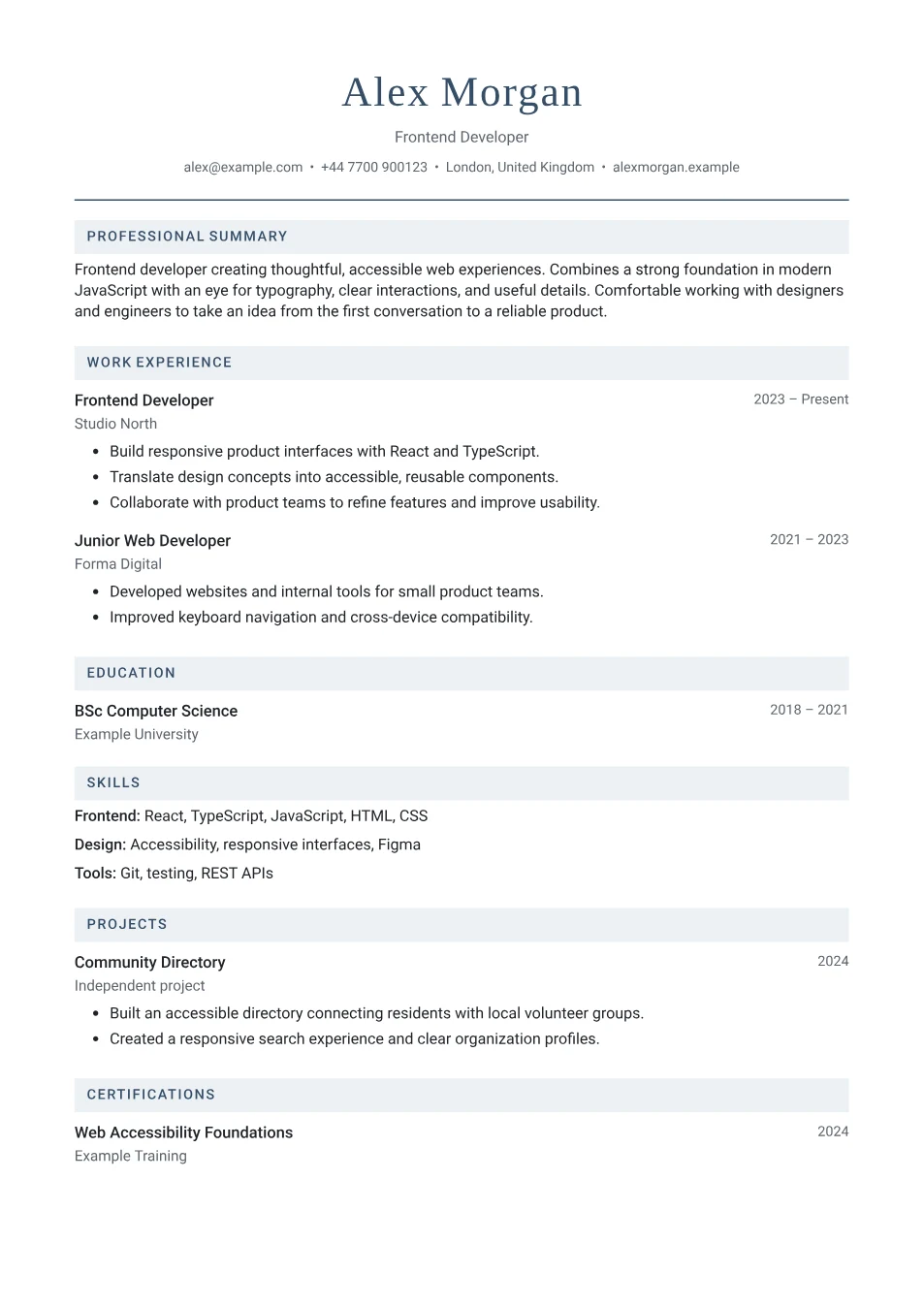
Folio's student CV maker starts with an education-first order and downloads A4 PDFs without payment or signup. Save a browser or portable draft before closing the tab. Open the downloaded file, check every page, and follow the employer's requested file format.
- Correct course status and dates.
- An accurate contribution behind each skill.
- Working contact details and accessible links.
- The required application documents and answers.
Sources: LSE Careers: CVs, profiles, and application structure
Check your UK student application
- Completed and predicted results are clearly distinguished.
- Your strongest relevant activity appears early enough to find.
- An unpaid activity is labelled accurately.
- You have permission and a separate process for any requested references.
- The CV, form answers, and cover letter agree on dates and responsibilities.
Frequently asked questions
Must I publish my referees' phone numbers on a UK student CV?
The National Careers Service advises against putting another person's contact details on the CV. Ask permission and provide references separately through the employer's requested process.
Can I include an unfinished degree?
Yes. State the course and institution and make the expected completion date or current status clear.
Where should I put a society or volunteer role?
Use Activities, Volunteering, or a clearly labelled experience entry. Choose a heading that makes the context understandable and describe your own responsibility.
Sources and further reading
Sources checked on . Examples are fictional; practical suggestions are Folio's own application of the guidance.