An American resume is a concise, achievement-focused summary of your experience, usually one page early in your career and up to two pages for most experienced candidates. US recruiters expect quick evidence of results, a clean reverse-chronological layout, and no personal details beyond how to reach you.
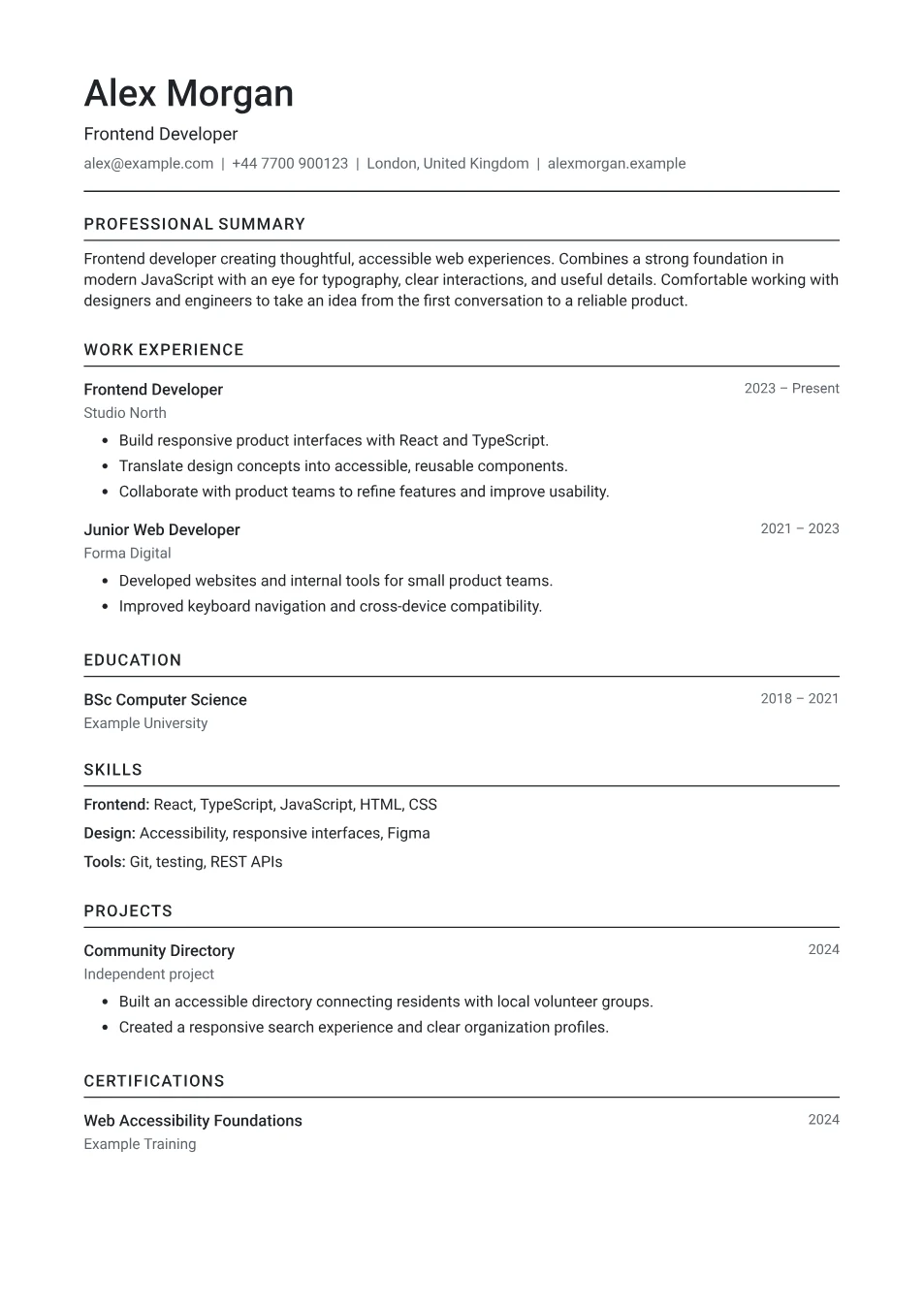
The standard US resume format
The reverse-chronological resume is the most common format in the United States. It starts with your contact details and a short professional summary, then lists work experience from most recent to oldest, followed by education and skills.
Contact details usually include your name, phone number, a professional email address, your city and state, and a LinkedIn profile or portfolio. A full street address is optional and often left out.
- Header: name, phone, email, city and state, and LinkedIn or portfolio.
- Professional summary: two to four lines, or a short objective if you are early in your career.
- Work experience: job title, employer, location, month and year, and achievement bullets.
- Education: degree, school, and graduation year.
- Skills: technical skills, tools, certifications, and languages.
How long should a US resume be?
One page is the usual expectation for students, recent graduates, and people with a few years of experience. Two pages are common for experienced professionals. Federal government jobs advertised on USAJOBS have their own resume requirements, including what each role must show, so follow the job announcement exactly.
The standard paper size in the US is Letter (8.5 × 11 inches) rather than A4. Folio currently downloads CVs as A4 PDFs. Most resumes are read on screen, where the difference is rarely noticeable, but if an employer asks for Letter size or you plan to print, check the layout first.
US resume format for students
Students and recent graduates in the US usually use a one-page resume with education near the top. List your school, your degree or expected degree, and your graduation month and year. Add your GPA if it is strong, followed by relevant coursework, honors, or a capstone project.
Campus jobs, internships, research assistant roles, volunteering, and leadership in student organizations all count as experience. Describe them with the same action-and-result bullets as any job. Our guides to writing an internship CV and describing projects show how.
- One page, with education first.
- Expected graduation month and year.
- GPA only when it strengthens the application.
- Relevant coursework, projects, or a capstone.
- Campus jobs, internships, and student organizations.
Lead with achievements and numbers
US resumes tend to be direct about results. Start each bullet with a strong verb, say what you did, and add the outcome: how much, how many, how fast, or what changed. Use figures you can explain in an interview, and describe your share of team results honestly.
If you cannot measure a result, describe its scope instead: the size of the team, the number of customers, the budget you managed, or the systems you worked with. Our guide to describing work experience has more examples.
What to leave off an American resume
Do not include a photo, date of birth, age, marital status, religion, or Social Security number. US employers are careful to avoid information connected with characteristics protected by federal equal employment opportunity laws, and these details add nothing to your application.
References are not listed on the resume. Prepare a separate list of two or three references and share it when an employer asks. The line “References available upon request” is unnecessary.
- A photo, date of birth, or age.
- Marital status, children, or religion.
- Your Social Security number or passport details.
- Salary history.
- A list of references.
Applying from outside the US
If you are applying from another country, convert your document to US conventions: American spelling, one or two pages, and job titles a US reader will recognise, while staying accurate to the role you held. Give context for employers that a US reader may not know, for example “Northbridge Bank, a national retail bank with 3,000 staff”, and describe qualifications in terms of their closest US equivalent.
Be clear about work authorization. If you are a US citizen or permanent resident, or already hold a visa that allows you to work, you can say so briefly. If you will need sponsorship, answer the employer’s questions accurately in the application form.
A free American resume template
For US jobs, choose a simple layout that fits on one page. Clarity and Linear use plain, single-column structures that read well on screen and in applicant tracking systems, and Compact fits more onto one page. Leave the photo out.
Build your resume in the free CV maker, which works as a free resume builder for US jobs with no sign-up or watermark. It downloads A4 PDFs; most US applications are read on screen, but check the layout if an employer asks for Letter size.
Professional summary or resume objective?
A professional summary works best when you have relevant experience to sum up. A resume objective, which states the role you want and what you bring to it, is more useful for students, recent graduates, and career changers. Either way, keep it short and specific to the job.
For a first draft you can edit, try the free resume summary builder or the resume objective generator.
Frequently asked questions
Should a US resume be one page?
One page is the usual expectation if you are a student, a recent graduate, or early in your career. Experienced candidates commonly use two pages. Federal applications on USAJOBS have their own rules.
Do I put my address on a US resume?
City and state are enough for most applications. Add a full address only if the employer asks for it.
Is a CV the same as a resume in the US?
No. In the US, a CV usually means a longer academic or research record. For most jobs, send a resume. See resume vs CV for the difference.
Should I include a photo on a resume for US jobs?
No. Photos are not expected on American resumes. For acting and modelling work, a headshot is usually requested separately.