Projects are some of the most convincing evidence on a CV, because they show what you can do rather than what a job title says. They matter most when you are a student, changing careers, or working in a field such as technology or design, but a well-described project helps almost any application.
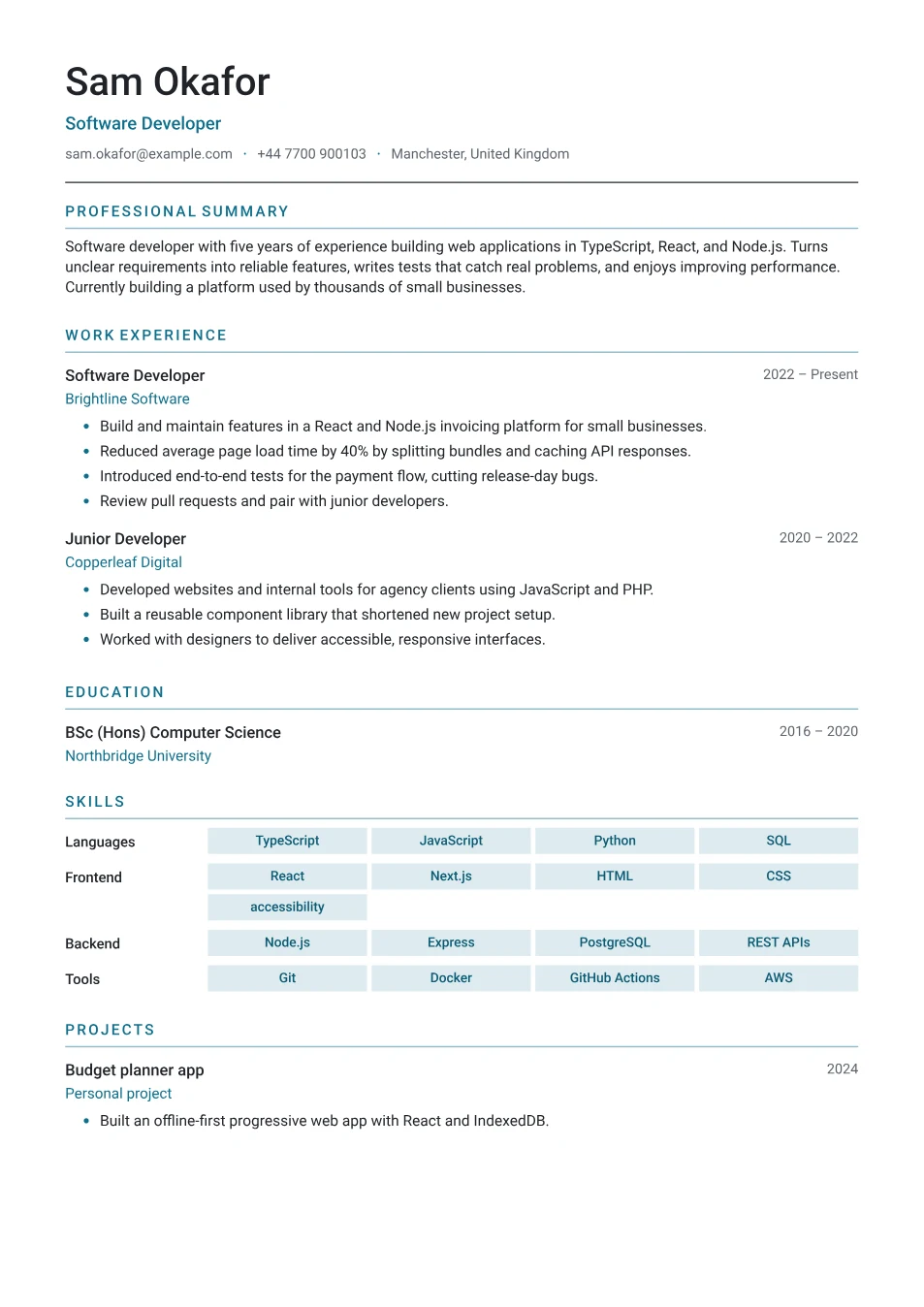
When a projects section helps
Add projects when they show skills the job needs and your work history does not show them well on its own.
- You are a student or graduate with little work experience.
- You are changing careers and have built something in the new field.
- You work in technology, design, research, or marketing, where portfolios are common.
- A volunteer or community project shows leadership or organisation.
- A project at work was large enough to deserve its own entry.
Where projects go on your CV
Most CVs list projects in their own section after work experience. If projects are your strongest evidence, move the section higher, directly after education for students or after your profile for career changers. In Folio you can reorder sections in the Templates & layout tab.
Projects you completed as part of a job can stay inside that role’s bullet points. Give one its own entry only when it is substantial and directly relevant to the application.
What to include for each project
Keep each project short and specific. One to three bullet points is usually enough.
- Project name: a clear, descriptive title rather than an internal code name.
- Context: the course, organisation, or “Personal project”, or a link to the work.
- Dates: the year, or the months it ran.
- What you did: your goal, your role, and the tools or methods you used.
- The result: what you delivered, who used it, or what changed.
Write project bullets that show results
Use the same formula as for work experience: start with an action, say what you made or did, mention how, and finish with a result. Our guide to describing work experience covers the same approach for jobs.
If the project is small, scale is still worth stating: how many users, pages, participants, or data points. Use figures you can explain in an interview.
Project examples by type
Fictional examples written in the format above. Replace every detail with your own.
Group projects: describe your part
Most projects are team efforts, and that is fine. Say how big the team was and what you personally did: “With a team of four, designed the survey and analysed the results.” Readers trust a clear, modest description more than a vague claim to have led everything.
Links, portfolios, and GitHub
A link lets a reader see the work for themselves, but only if it works and the work is presentable. Check every link before you send your CV, give code repositories a short README, and remove unfinished or abandoned work from the places you link to.
Only share work you have permission to show. For client or employer projects, describe the work without confidential details, or ask before including screenshots or links.
Frequently asked questions
How many projects should I put on my CV?
Two or three relevant projects is usually enough. Choose the ones closest to the job, and describe them properly rather than listing many briefly.
Do personal projects count on a CV?
Yes. A personal project shows initiative and real skills, especially for students and career changers. Describe it as seriously as a work project, with what you made and what came of it.
Can I include an unfinished project?
Yes, if it already shows useful skills. Say what you have built so far, describe it as in progress, and do not overstate what it does.
Should projects go in experience or in their own section?
Use a separate Projects section for academic, personal, and volunteer projects. Keep projects you did as part of a job in that job’s bullet points.