Resume and CV can mean the same document or two very different ones, depending on where you apply. The difference matters less than you might fear: once you know which document an employer expects, the rules for writing a good one are much the same.
The short answer
In the United States and Canada, a resume is the short document most people send with a job application, usually one or two pages. A CV (curriculum vitae) is a longer, complete record of an academic or research career, used for roles in universities, research, and medicine.
In the UK, Ireland, New Zealand, and much of Europe, CV is simply the everyday word for the document you send with a job application. It is close to what Americans call a resume. In Australia, resume and CV are both common and usually mean the same thing.
So when a UK employer asks for a CV and a US employer asks for a resume, they are usually asking for the same kind of document: a focused summary of your experience, written for the job.
| Where you apply | Usual word | What it means | Typical length |
|---|---|---|---|
| United States | Resume | A focused summary written for one job | 1–2 pages |
| Canada | Resume | A focused summary written for one job | 1–2 pages |
| UK and Ireland | CV | The same kind of document as a resume | Usually 2 pages |
| Australia | Resume or CV | Usually used interchangeably | Often 2–3 pages |
| Academic and research roles | CV | A complete record of research, teaching, and publications | As long as it needs to be |
What goes into a resume
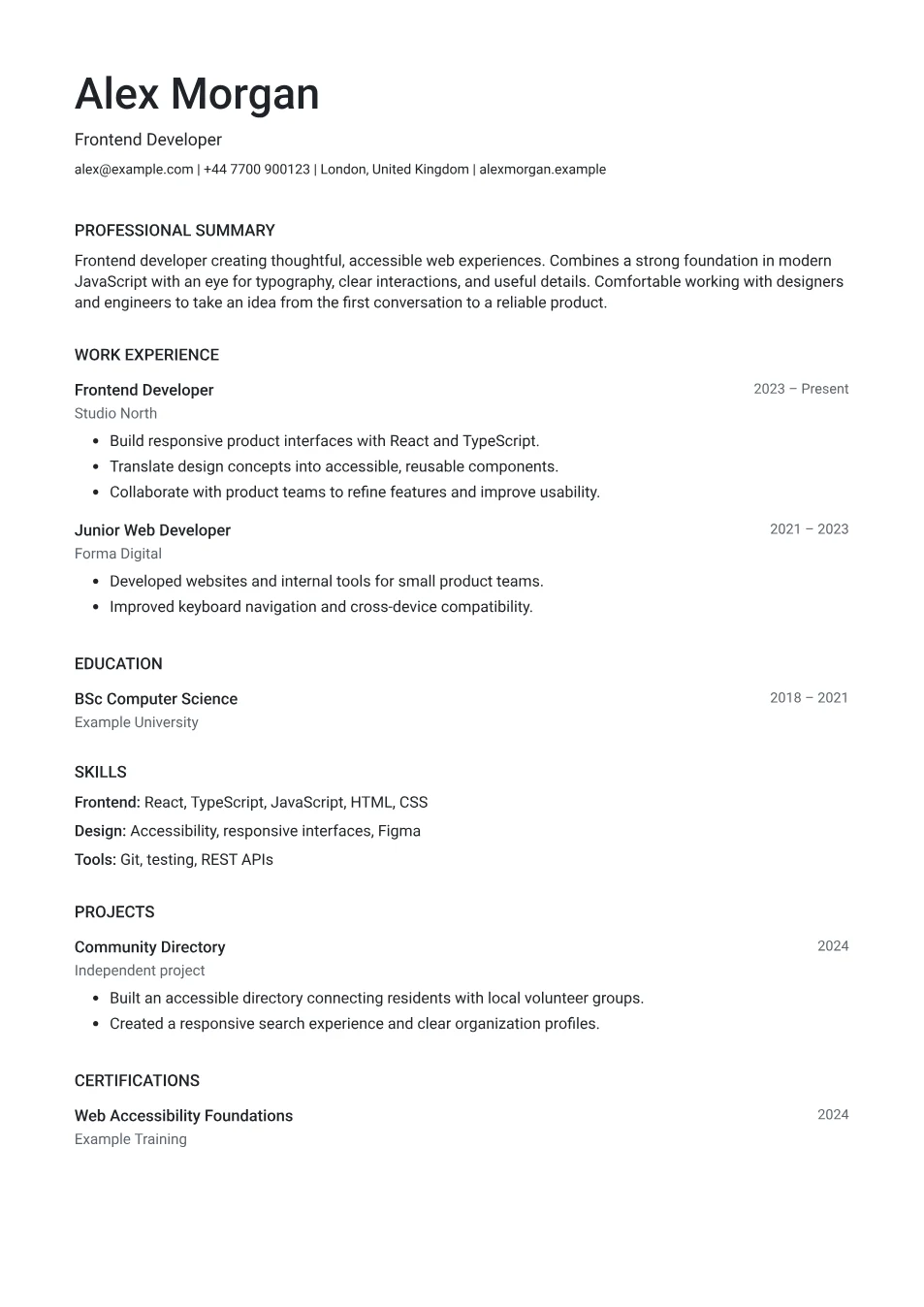
A resume is selective. It brings forward the experience, skills, and results most relevant to the role, and leaves the rest out. Most resumes include contact details, a short professional summary, work experience in reverse chronological order, education, and skills. Projects, certifications, volunteering, and languages are added when they support the application.
Because a resume is tailored, two applications can use two versions of it. Changing the order of your points, the skills you list, or the wording of your summary for each job is normal, as long as everything stays accurate.
What makes an academic CV different
An academic or research CV aims to be complete rather than selective. Alongside education and employment, it typically lists publications, conference presentations, research grants, teaching, supervision, awards, and professional service. Its length grows with your career, and several pages are normal for experienced researchers.
If a university, research institute, or medical training programme asks for a CV, check whether they mean this longer format. Their guidance or the job advert usually lists the sections they expect. For most other jobs, even at organisations connected with research, a resume-length document is what readers want.
Other names you might see
A few related terms come up in job adverts and application guidance.
Personal statement, profile, or summary
In the UK, the short introduction at the top of a CV is often called a personal statement or profile. In the US and Canada, the same paragraph is usually called a professional summary, or a resume objective for early-career applicants. Folio calls it a Profile; the heading on your document can be whichever the employer expects.
Europass CV
Europass is a standard CV format provided by the European Union. Some employers and education providers in Europe ask for it specifically. If an advert does not mention Europass, a well-structured CV in your own layout is usually fine.
Biodata
In some countries in South Asia, a biodata is a document that includes personal details such as date of birth and family information. For jobs in the US, UK, Canada, or Australia, leave those details out and use a resume or CV format instead.
Which one should you send?
Use the word in the job advert. If it asks for a resume, send a resume; if it asks for a CV, check whether the role is academic. For a non-academic job, a focused document of one to two pages works in nearly every case, whatever it is called.
You do not need a different design for each word. A clean layout with standard headings works as either. In Folio you can start a CV in the free editor, download a portable draft, and keep a separate version for each application.
- US or Canadian job: a resume, usually one page early in your career and up to two pages with more experience.
- UK or Irish job: a CV, usually up to two pages.
- Australian job: a resume or CV, commonly two to three pages.
- Academic, research, or medical role: ask whether a full academic CV is expected.
Name the file the way the employer does
Name the PDF with your name and the word the employer used, such as “Priya Shah CV.pdf” or “Jordan Lee Resume.pdf”. It is a small detail, but it makes your file easy to find and shows that you read the advert carefully.
Frequently asked questions
Is a CV longer than a resume?
In the US and Canada, yes: a CV means a full academic record and can run to many pages, while a resume is one or two pages. In the UK and Australia, CV usually means the same document as a resume, so the length is similar.
Can I use the same document for UK and US applications?
Mostly, yes. Change the spelling to match the country, adjust the length if needed, and check personal details: neither country expects a photo, date of birth, or marital status. Our guides to the UK CV format and the US resume format cover the differences.
Should I call my document a CV or a resume?
Use the word the employer uses. If the advert does not say, use the word that is normal in that country: CV in the UK and Ireland, resume in the US and Canada, and either in Australia.