A Canadian resume is a focused, one- or two-page document that shows your experience and results in reverse chronological order. Its conventions are close to the American resume, with a few Canadian details: no personal information such as age or a photo, consistent Canadian spelling, and room for language skills and volunteer work.
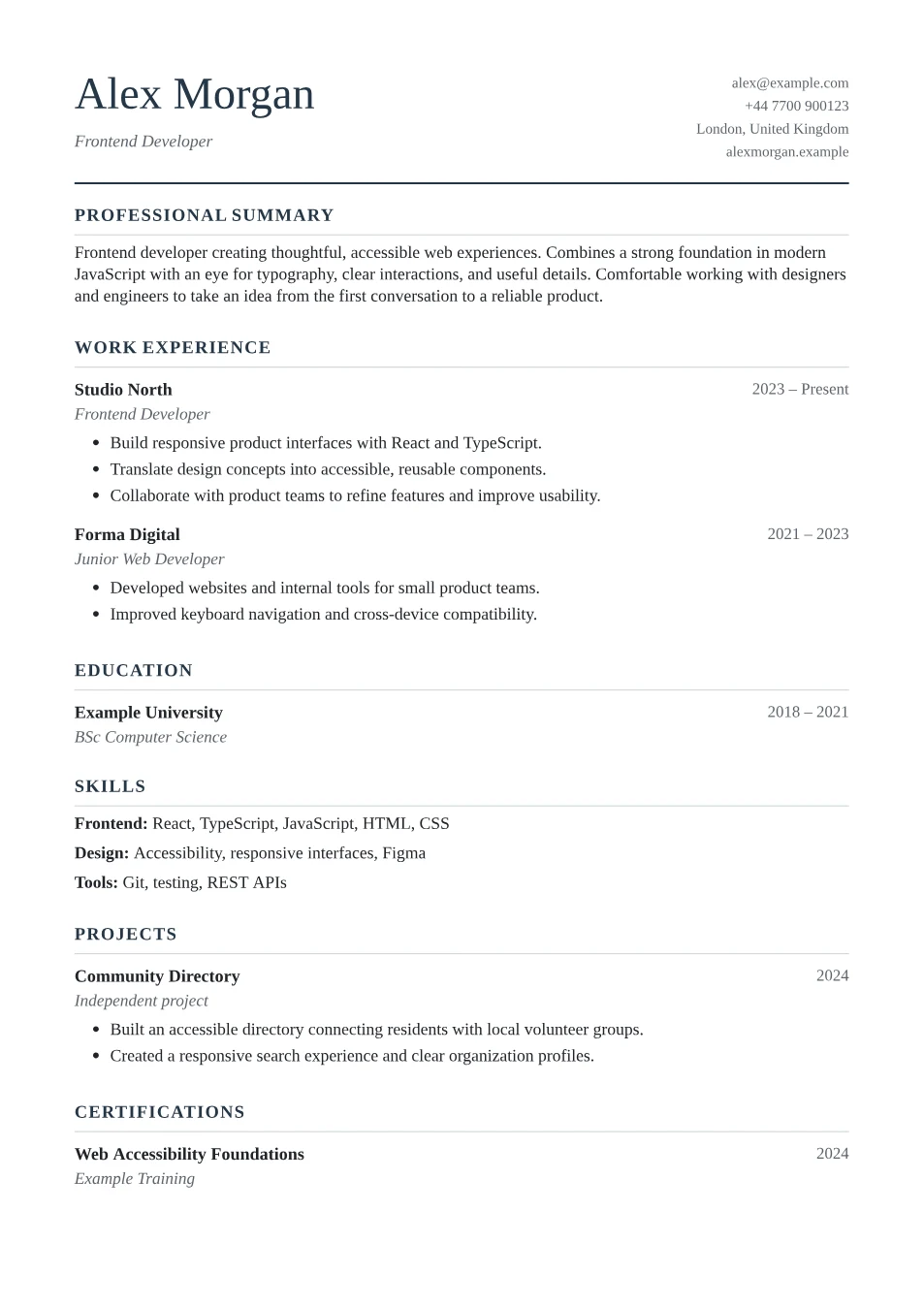
The standard Canadian resume format
Most Canadian resumes open with contact details and a short professional summary, followed by work experience, education, and skills. Add certifications, volunteer experience, and languages when they support the application.
- Contact details: name, phone, email, city and province, and a LinkedIn profile.
- Professional summary: three or four lines tailored to the role.
- Work experience: title, employer, city, dates, and achievement-focused bullets.
- Education, including the Canadian equivalent of international qualifications where you know it.
- Skills, languages, certifications, and volunteer experience.
Length, paper size, and spelling
Aim for one to two pages. Recent graduates can usually fit everything on one page, and experienced candidates often use two. Canada uses Letter-size paper, like the US. Folio downloads A4 PDFs, which display normally on screen, so check the layout if an employer asks for Letter size or you plan to print.
Canadian spelling mixes British and American conventions: centre, colour, and licence, but often organize and analyze. Choose one style and use it consistently. When applying to a particular organisation, it is sensible to follow the spelling in its job advert.
What to leave out
Canadian human rights laws protect applicants from discrimination on grounds such as age, sex, religion, marital or family status, and national or ethnic origin. Employers therefore do not expect these details on a resume. Leave out your photo, date of birth, marital status, and Social Insurance Number (SIN).
- A photo.
- Date of birth or age.
- Marital status or the number of children you have.
- Your Social Insurance Number (SIN).
- References: provide them separately when asked.
Show your language skills
English and French are both official languages, and some roles, including many in the federal public service and in Quebec, require bilingual skills. List each language with an honest level, for example “French: professional working proficiency”. If you have taken a recognised language test, or hold a public service language rating, include the result.
Folio has a dedicated Languages section. Add each language with its level, and two-column templates place it beside your skills.
Tips for newcomers to Canada
Moving your career to Canada usually means translating your experience for a new reader.
Explain your international experience
Employers may not recognise overseas companies or job titles. Add a short description of the organisation, such as its industry or size, and use a title a Canadian reader will understand while staying accurate to the role you held.
Translate your qualifications
If you have had your education assessed, for example through an educational credential assessment, give the Canadian equivalent next to your qualification. For regulated professions such as nursing, engineering, or teaching, state where you are in the provincial licensing process.
Show local connections where you have them
Canadian volunteering, courses, and bridging programs all help an employer picture you in the role. If you have an open work permit or permanent residence, you can mention it briefly in your summary or contact details.
A free Canadian resume template
A clean, single-column layout suits Canadian applications, including for newcomers adapting an international CV. Linear, Clarity, and Professional keep the structure plain and leave out the photo.
Use the free CV maker as a Canadian resume builder: add your English and French levels in the Languages section, and rename the extra section to Volunteering for Canadian volunteer work. It downloads A4 PDFs, which display normally on screen; check the layout if an employer asks for Letter size.
A resume for jobs in Canada with no experience
If you are a student or new to the Canadian job market, lead with education, projects, volunteer work, and transferable skills. Part-time jobs, co-op placements, and community involvement all count.
Our guide to writing your first CV explains how to describe them, and the CV maker for students starts you with an education-first layout.
Frequently asked questions
How long should a Canadian resume be?
One to two pages. Students and recent graduates usually need one page; experienced candidates often use two.
Should I include a photo on a Canadian resume?
No. Photos are not expected and can raise concerns about bias. Leave one out unless the role specifically asks for it.
Do I need to mention my work permit status?
It is optional, but a short note such as “Permanent resident” or “Open work permit” can answer an employer’s question early. Be accurate, and answer any application form questions honestly.
Should newcomers use a Canadian resume format?
Yes. Use the Canadian conventions: reverse chronological order, one to two pages, no personal details, and context for international employers and qualifications.