A cover letter is your chance to connect your experience to one specific job, in your own voice. The best ones are short, specific, and clearly written for the employer reading them. This guide walks through the format paragraph by paragraph, with an example you can adapt.
When you need a cover letter
Send a cover letter whenever the advert asks for one, and consider one whenever the application allows it. It is especially useful when you are changing careers, applying for your first job, explaining a gap, or applying to a smaller organisation where a person reads every application.
If an online form only has a “message to the employer” box, a shortened cover letter works there too. A few clear sentences about why you fit the role are better than leaving it blank.
The professional cover letter format
A cover letter usually fits on one page and follows a familiar business-letter layout. Use the same name and contact details as your CV, so the two documents look like a set.
Aim for roughly 250 to 400 words. That is enough to make your case without repeating your CV.
- Your name and contact details at the top.
- The date, and the employer’s name and address if you know them.
- A greeting, addressed to a named person where possible.
- An opening paragraph: the role, and why you are a good fit.
- One or two middle paragraphs: evidence that you can do the job.
- A closing paragraph: your interest, your availability, and a thank you.
- A sign-off and your name.
Who to address it to
Use the hiring manager’s name if the advert gives it, or if you can find it on the organisation’s website. “Dear Ms Patel” or “Dear Alex Morgan” is fine. If you cannot find a name, “Dear Hiring Manager” is widely accepted and better than a guess.
In British English, a letter to a named person traditionally ends with “Yours sincerely”, and one that begins “Dear Sir or Madam” ends with “Yours faithfully”. In the US and Canada, “Sincerely” is standard. “Kind regards” is accepted almost everywhere, especially by email.
Write an opening that gets to the point
Name the role and give one strong reason you are a good fit. Mention where you saw the advert if it is relevant, or the person who referred you. Skip general sentences about how excited you are, and show your interest through specifics instead.
Use the middle paragraphs for evidence
Pick two or three requirements from the job description and give an example for each: what you did, how you did it, and what changed. This is where you go beyond your CV, explaining the context behind a result or why a project matters for this job.
Use the employer’s terminology for skills you genuinely have. The resume keyword checker shows which terms from the advert your application already covers.
A cover letter with no experience
If this is your first job, an internship, or a move into a new field, the letter matters even more, because it explains what your CV cannot show on its own. Lead with your motivation for this specific role, then give evidence from study, projects, volunteering, part-time work, or activities.
Do not apologise for a lack of experience. Describe what you have done and what it taught you, and connect it to what the employer needs. One specific example is worth more than a list of qualities.
- Name the role and say why this employer interests you.
- Give one or two examples from your course, a project, volunteering, or a part-time job.
- Connect each example to a requirement in the advert.
- Mention your availability, such as a graduation date or start date, if it matters.
- Choose the student or graduate template in the cover letter maker for a first draft written for early-career applicants.
Close with confidence
Summarise why you are interested in the role, mention your availability if it matters, and thank the reader. A sentence such as “I would welcome the chance to discuss how I could help your team” is enough. You do not need to demand an interview or repeat your contact details in the paragraph.
A complete cover letter example
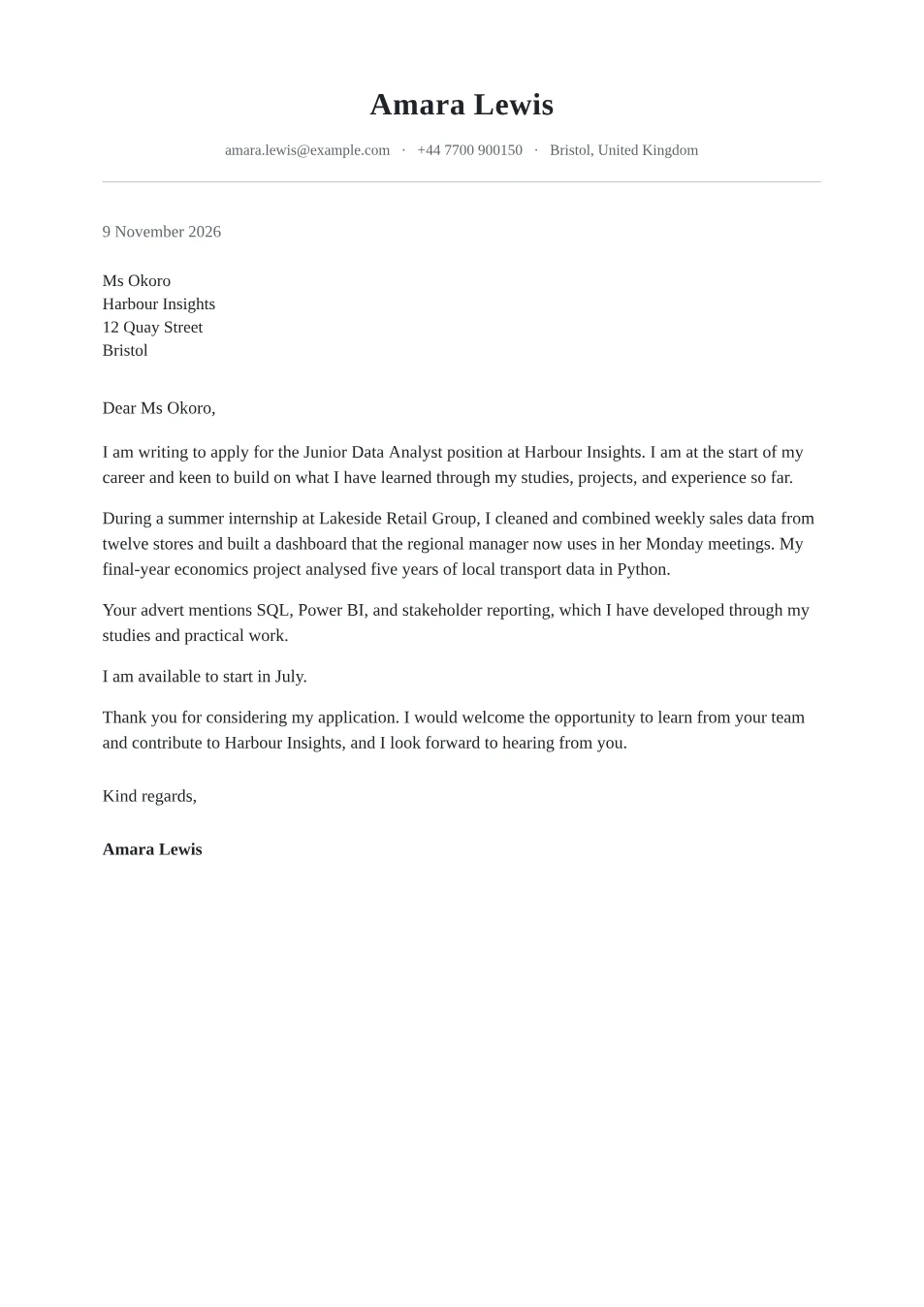
This fictional example shows how the paragraphs fit together. Keep the structure, and replace every detail with your own.
Common cover letter mistakes
Most weak cover letters share the same few problems, and each one is easy to fix.
- Sending the same letter to every employer, or leaving another company’s name in it.
- Repeating your CV line by line instead of adding context.
- Writing more than one page.
- Opening with “To whom it may concern” when a name is easy to find.
- Focusing on what you want from the job rather than what you offer.
- Forgetting to proofread names, dates, and the job title.
Frequently asked questions
How long should a cover letter be?
One page at most: usually three to five short paragraphs, or about 250 to 400 words.
How do I write a cover letter with no experience?
Focus on why you want this role and what you can already offer. Use examples from your studies, projects, volunteering, or part-time work, and link each one to the advert. See the section on writing a cover letter with no experience above.
Do I need a cover letter if it is optional?
Not always, but a short, tailored letter can help, especially if you are changing careers, applying for your first job, or explaining a gap.
Should my cover letter match my CV?
Yes. Use the same name, contact details, and a similar typeface, so the documents look like a set. The free cover letter maker can reuse the details from the CV open in your editor.
Can I put my cover letter in the body of an email?
Yes, if the employer asks you to apply by email. Write a shorter version in the message and attach your CV, or attach both as PDFs if the advert asks for a separate letter.