Australian resumes tend to be a little longer and more detailed than American ones. Two to three pages is common, referees often appear at the end, and employers appreciate a clear statement of your work rights. The essentials are the same everywhere: relevant experience, clear results, and a layout that is easy to scan.
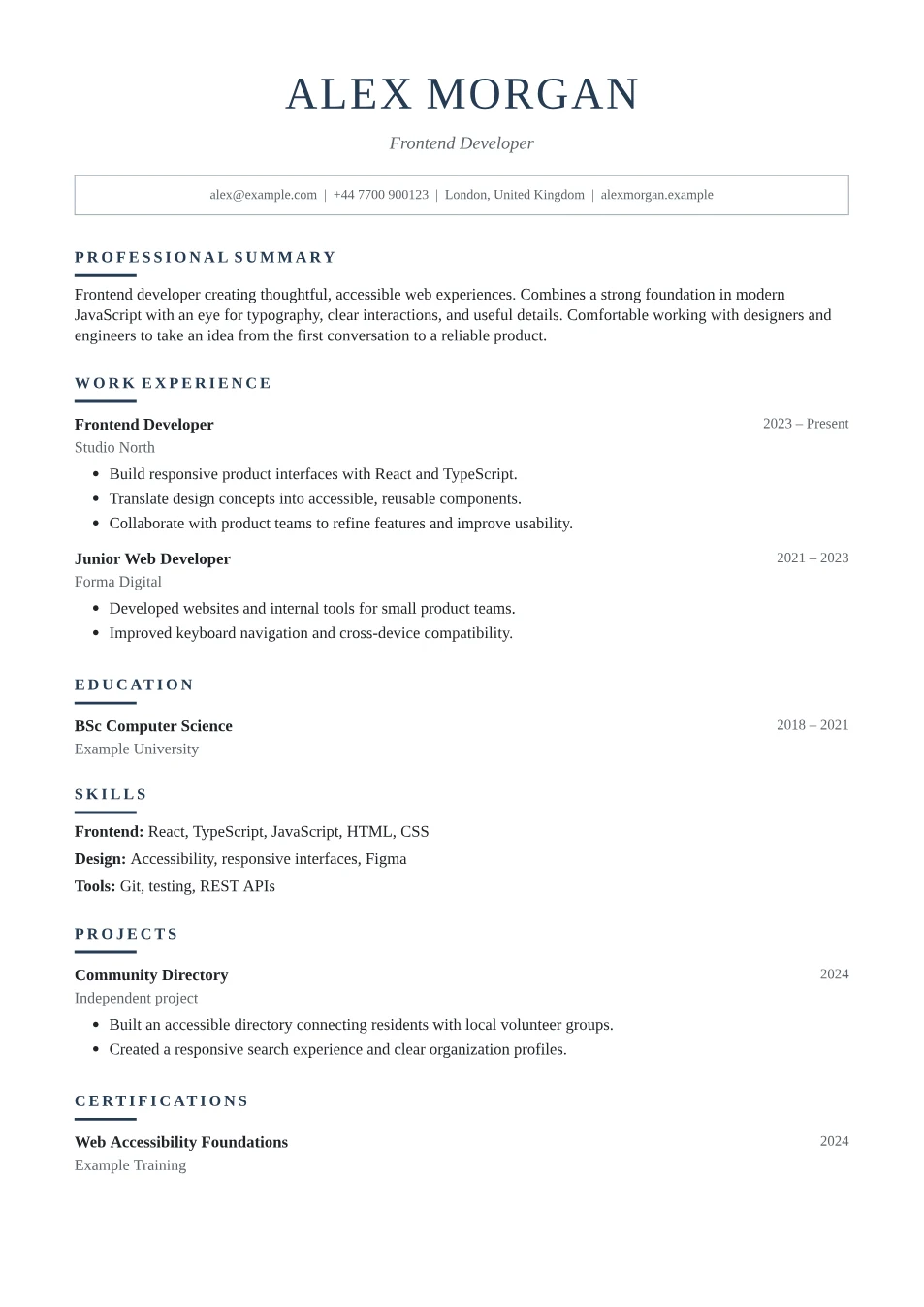
The standard Australian resume format
Start with your name, phone, email, suburb and state, and a LinkedIn profile if you have one. Add a career summary, then key skills, employment history in reverse chronological order, education and training, and referees.
- Contact details, including your suburb and state.
- Career summary: a short paragraph tailored to the role.
- Key skills, often as a short list near the top.
- Employment history, with achievements for each role.
- Education, training, licences, and certifications.
- Referees, or a note that they are available on request.
How long should an Australian resume be?
Two to three A4 pages is common for experienced applicants, and one to two pages is usually enough for students and recent graduates. Longer is not better: every line should still be relevant to the job. Australia uses A4 paper, the size Folio downloads.
Use Australian spelling, which mostly follows British conventions, such as organisation, colour, and centre.
Referees on an Australian resume
Australian resumes often end with two referees, usually recent managers or supervisors, with each person’s name, job title, organisation, and contact details. Ask permission before listing anyone, and let them know which roles you are applying for.
If you would rather not share referees’ details with every application, write “Referees available on request” instead. In Folio, rename the Additional information section to Referees and put each referee on a separate line.
State your work rights
Employers need to know that you can legally work in Australia. A short line near your contact details, such as “Australian citizen”, “Permanent resident”, or a description of your visa and its work conditions, saves them having to ask. Make sure it is accurate and up to date.
Key selection criteria for government jobs
Australian Public Service and state government roles often ask you to respond to key selection criteria, or to write a short pitch explaining your suitability. Address each criterion with a specific example, commonly using the STAR structure: the situation, the task, the action you took, and the result.
Keep your resume consistent with the examples you use, so the reader can see where each one happened.
Include licences and checks relevant to the role
Many Australian jobs require specific licences or checks. List the ones you hold and any expiry dates, for example a driver licence, a forklift licence, a Working with Children Check, a National Police Check, a construction White Card, or a Responsible Service of Alcohol (RSA) certificate for hospitality work. Folio’s Certifications section is the right place for them.
A free Australian resume template
Australian resumes have room for more detail, so a layout with clear section headings helps a reader find your key skills and referees quickly. Professional, Regent, and Clarity work well, and all download as A4 PDFs, the standard size in Australia.
In the free CV maker, use the Certifications section for licences and checks, and rename the Additional information section to Referees. It works as a free Australian resume builder, with no sign-up or watermark.
A resume for Australian jobs with no experience
The Australian CV format for students follows the same structure with education first, then part-time and casual work, volunteering, and school or university activities. Casual roles in retail and hospitality are valuable evidence of reliability and customer service.
See how to write your first CV, and start with an education-first layout in the CV maker for students.
Frequently asked questions
How many pages should an Australian resume be?
Two to three pages is common for experienced applicants. Students and recent graduates can usually keep to one or two.
Do I need referees on my resume in Australia?
Including two referees at the end is common, but “Referees available on request” is also acceptable. Always ask your referees first.
Is it a resume or a CV in Australia?
Both words are used and usually mean the same document. Use the word in the job advert.
Should I include a photo on an Australian resume?
No. Photos are not expected for most jobs, and leaving one out keeps the focus on your experience.