A UK CV is a short, factual document, usually two A4 pages, that introduces your experience and makes it easy for an employer to shortlist you. British conventions are simple once you know them: no photo, no personal details beyond how to contact you, and a clear focus on evidence.
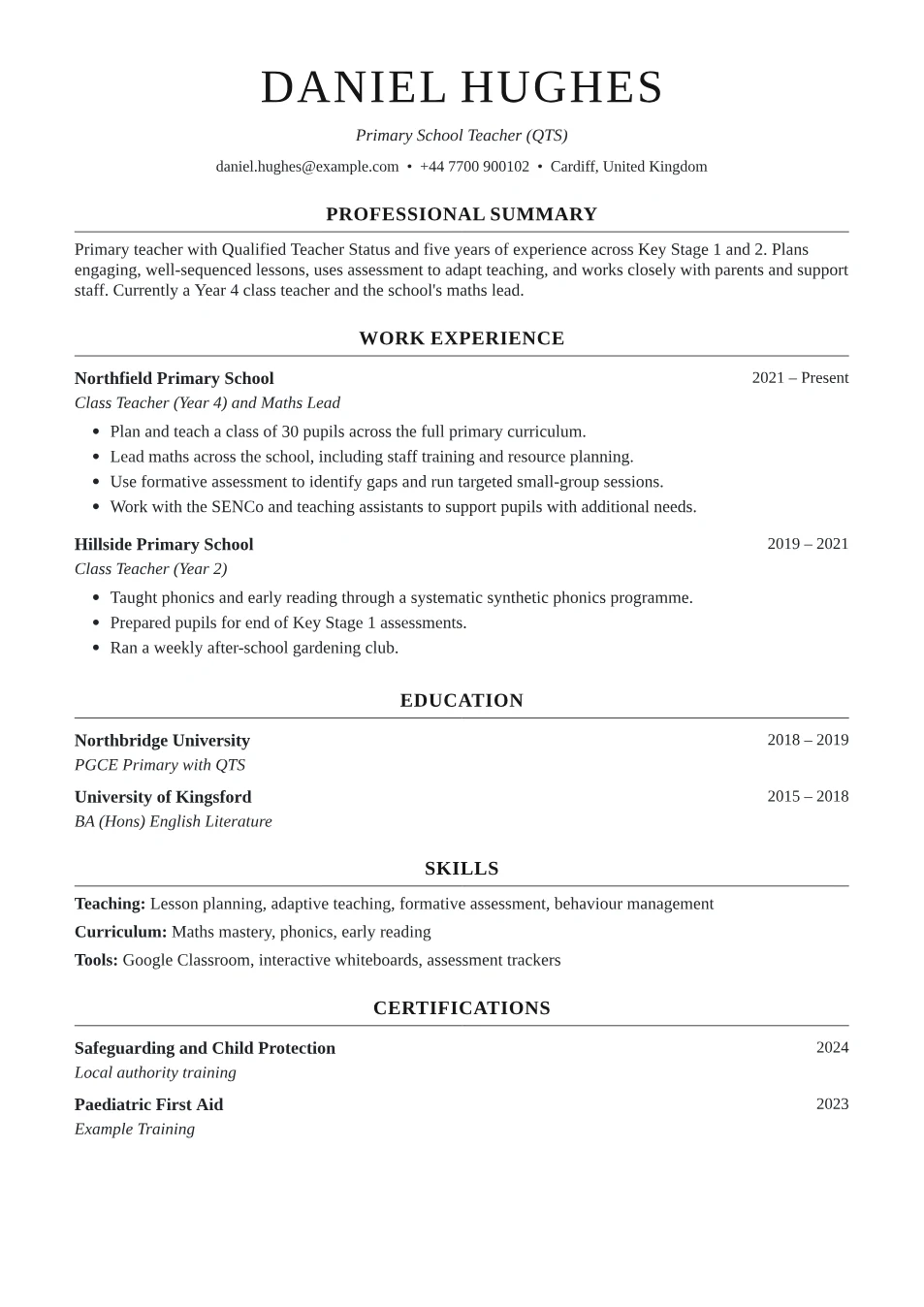
The standard UK CV structure
Most UK CVs follow the same order. Start with your name and contact details, followed by a personal statement, also called a profile. Then list your work experience, most recent first, followed by education, skills, and any other relevant sections such as certifications, volunteering, or languages.
If you are a student or recent graduate, put education before experience, because it is your strongest evidence. If you have years of relevant experience, keep education short and place it after your roles.
- Name and contact details: phone, email, town or city, and a LinkedIn or portfolio link if relevant.
- Personal statement: three to five lines about who you are and what you offer.
- Work experience: job title, employer, dates, and achievements for each role.
- Education: qualifications, institutions, and dates.
- Skills, plus optional sections such as certifications, languages, or volunteering.
Length, layout, and spelling
Two A4 pages is the usual length for a UK CV. One page can be enough for school leavers and some graduates; more than two is normally reserved for academic, medical, or very senior roles. A4 is the standard paper size in the UK, and it is the size Folio downloads.
Use British spelling throughout: organised, programme, licence (as a noun), and colour. Write dates consistently, for example “Sept 2022 – Present”, and use the same style for every entry.
What to leave out of a UK CV
UK employers do not expect a photo, date of birth, age, marital status, nationality, or religion on a CV. Leaving them out keeps the focus on your experience and is consistent with UK equality law, which protects candidates from discrimination on characteristics such as age, race, religion or belief, and marriage and civil partnership.
You also do not need your full home address; a town or city is enough. The line “References available on request” is no longer necessary, because employers ask for referees when they need them. Use the space for something useful instead.
- A photo, unless the role is in acting, modelling, or presenting.
- Date of birth, age, or marital status.
- Your National Insurance number.
- Salary history, unless the advert asks for it.
- A full postal address.
Mention your right to work when it helps
If your education or recent experience abroad might lead an employer to wonder whether you need a visa, a short line can answer the question early, for example “Full right to work in the UK” in your contact details or personal statement.
If you need sponsorship, check whether the employer is a licensed sponsor before applying, and answer the application form’s questions accurately.
UK CV format for students and school leavers
School leavers can list GCSEs and A levels, or Scottish Highers, BTECs, or T Levels, with grades, most recent first. If you have many GCSEs, summarise them on one line, for example “9 GCSEs at grades 9–5, including English and Maths”. University students and graduates can give their degree title, institution, dates, and expected or achieved classification, such as a 2:1.
Part-time jobs, volunteering, the Duke of Edinburgh’s Award, sports clubs, and society roles all count as evidence. Our guide to writing your first CV with no experience shows how to describe them, and the CV maker for students starts you with an education-first layout.
A free UK CV template to start from
Any clear layout without a photo suits UK applications. In Folio’s free CV maker, the Classic and Professional templates give a traditional British look, and Clarity keeps everything in one plain column for online application systems. All of them download as A4 PDFs, the standard size for UK jobs.
Start in the free CV maker, leave the photo out, and use British spelling. You can switch templates at any time without retyping, so it is easy to compare a traditional British CV template with a more modern one.
Application forms and supporting statements
Many UK public sector employers, including the NHS, local councils, and the civil service, use online application forms instead of, or as well as, a CV. These often include a supporting statement where you explain how you meet each point of the person specification. The civil service may also ask for examples against the behaviours in its Success Profiles framework.
Use your CV as the source for your examples, but answer the questions the form asks, in the order it asks them. Copying your CV into a supporting statement rarely addresses the criteria directly.
Before you send a UK CV
Run through the final points below, then use our CV checklist and compare your CV with the advert in the resume keyword checker.
- Two A4 pages or fewer, unless the role calls for more.
- British spelling and consistent dates.
- No photo, date of birth, or marital status.
- A personal statement written for this job.
- Saved as a PDF, unless the employer asks for Word.
Frequently asked questions
How long should a CV be in the UK?
Usually two A4 pages. School leavers and some graduates can fit everything on one page, and academic or medical CVs can be longer.
Do UK employers want a photo on a CV?
No. Leave it out unless you are applying for acting, modelling, or presenting work where your appearance is part of the job, or the employer asks for one.
Should I put references on my UK CV?
No. You do not need referees’ names or the line “References available on request”. Have two referees ready, and give their details when the employer asks.
Is a personal statement the same as a CV profile?
Yes. The short introduction at the top of a UK CV can be called a personal statement, personal profile, or profile. Our guide to writing a CV profile has examples.