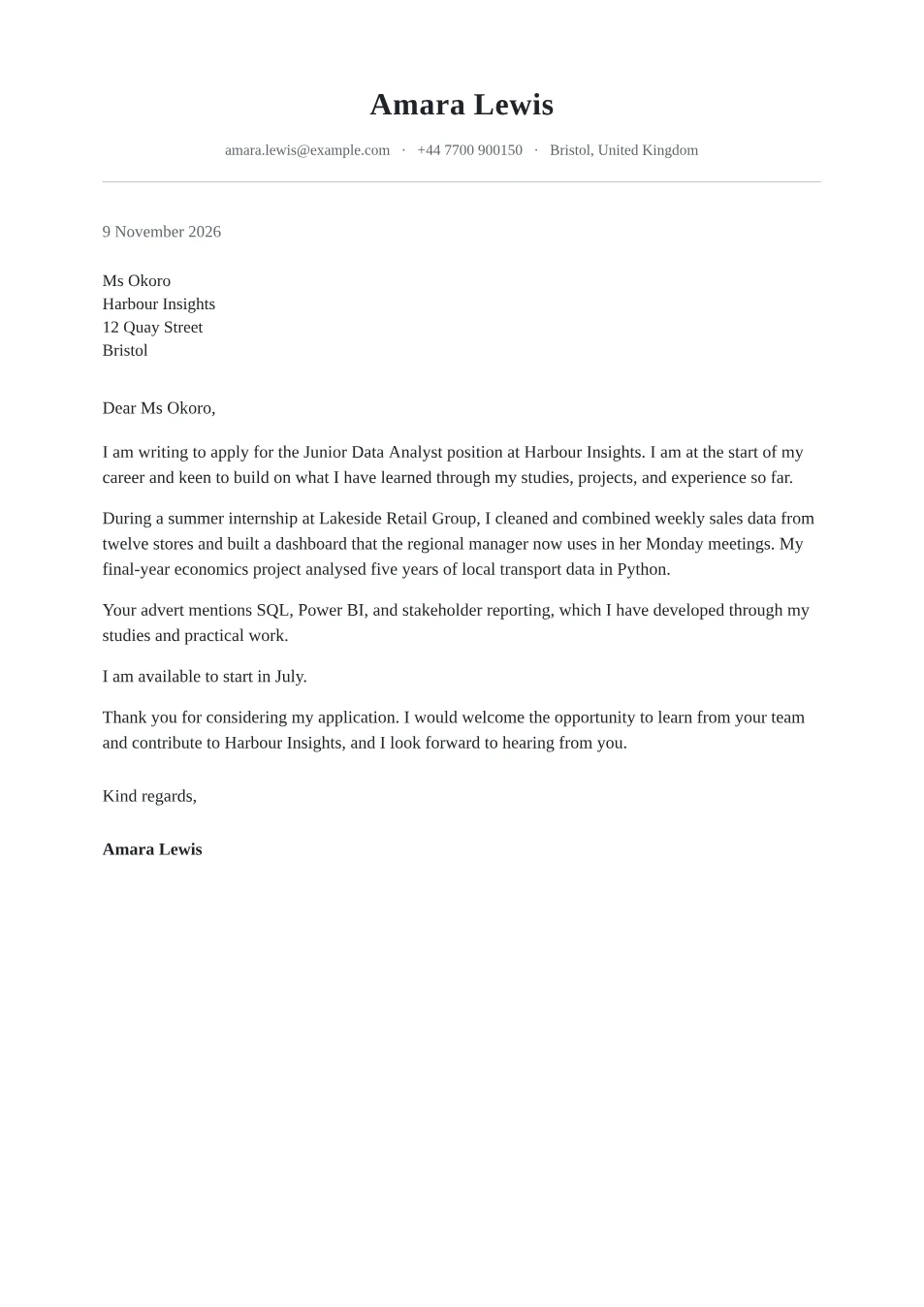
When you have no paid job history, a cover letter can explain why a school activity, project, or volunteer responsibility matters to the vacancy. Choose one useful example and make the connection explicit. The full sample and editing exercise below show how to do that without apologising for being new.
The short answer
Name the job, explain a specific reason for applying, and connect one real example to a requirement. Use study, volunteering, or projects where relevant. Close with the requested next step or availability. If the employer requests a supporting statement instead, answer its criteria and length limit.
See the worked exampleWorked example: connect a school responsibility to the advert
Imagine a receptionist advert mentions accurate records and greeting visitors. You kept a school club's attendance sheet and welcomed new members. Write that activity plainly, then explain its connection to the work. Do not claim experience with a booking system you have never used.
The revised paragraph below belongs in the middle of the letter. Add a role-specific opening and a brief closing around it; the longer sample later in this guide shows the whole structure. When adapting the paragraph, keep the setting and your level of responsibility visible.
Work out what the application asks for
The National Careers Service describes a cover letter as a short introduction, usually three to five paragraphs. Manchester's application guidance treats a supporting statement as a fuller response to the role's criteria. Check which task the advert asks for, including its length limit; a short letter does not replace required form answers.
Make a note of two requirements you can support through study, activities, projects, or volunteering. If the role is customer-facing, choose evidence involving people. If it involves organised records, choose a task where you managed information carefully. You need a connection, not a complete employment history.
Sources: National Careers Service: How to write a cover letter; University of Manchester: Supporting statements for job applications
Name the role and give a researched reason for applying
The National Careers Service recommends researching the employer and naming the vacancy, including its reference if supplied. Read the employer's own description of its work and choose a detail you can connect to your interest. State that connection in your own words instead of copying its mission statement.
Mention your current situation if it gives useful context: a school leaver seeking weekend work, a student applying for an internship, or someone returning to work after training. Keep the opening focused so there is room for your example.
Sources: National Careers Service: How to write a cover letter
Use one example to support a relevant strength
Describe the setting, what you did, and the useful outcome or responsibility. For a group project, distinguish your part from the group's overall result. For volunteering, state whether it was a one-off event or a regular commitment. These details make modest experience understandable.
Choose facts you can discuss comfortably at interview. Do not add an impressive-looking percentage to make an ordinary task seem more valuable. If you lack a measured outcome, explain what the task required and how you completed it.
Adapt the letter to the actual employer
Replace generic statements with a detail from the advert or the employer's own information that relates to your interest. Do not repeat the entire CV. Use the letter to explain why an example is relevant and what you want to contribute or learn.
The cover letter maker gives you an editable starting structure using predefined patterns. Read every line and remove anything that does not fit. Its output is a draft assembled from your details, not research into the employer or a guarantee of suitability.
Check the letter and CV together
Use consistent contact details, dates, and descriptions across both documents. Confirm the employer's name and the role title. Read the letter aloud, then open the downloaded file before attaching it. If the application uses a text box, check the pasted version for lost paragraph breaks.
Build the accompanying CV with no experience around the same evidence. For a fuller explanation of letter layout and addressing, read how to write a cover letter. A clear, accurate pair of documents is the goal.
Before you attach the first-job letter
- The role title, employer name, and any reference number are correct.
- You explain a reason for this application, not just a general wish for work.
- One example shows what you personally did.
- The letter and CV describe the same activity consistently.
- Every placeholder is replaced and the requested documents are attached.
Frequently asked questions
Should I say I have no experience in the opening?
You can state that you are applying for a first job, but use the space to explain your interest and relevant evidence rather than apologising.
Can I use a school activity as my example?
Yes. Explain your responsibility and contribution, keep the scale accurate, and connect it to a requirement in the advert.
Sources and further reading
Sources checked on . Examples are fictional; practical suggestions are Folio's own application of the guidance.