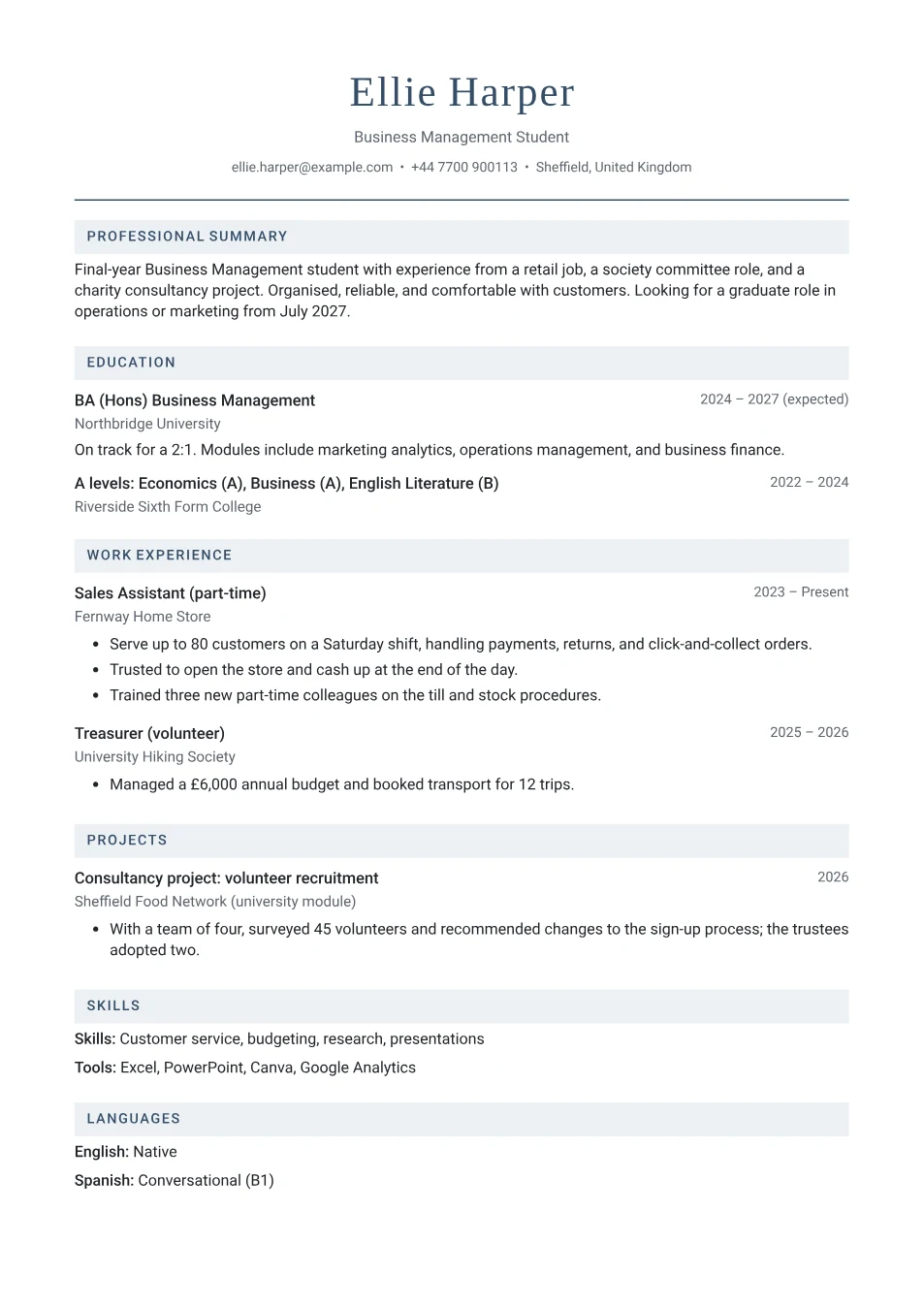
A student resume summary does not need to pretend you have a career behind you. It needs to introduce your current position and point to a useful piece of evidence. Start with your course or situation, add something you have actually done, and make the connection to the opportunity clear. The examples below show how that can work without an employment history.
Choose between a summary and an objective
A summary introduces the background you bring; an objective places more emphasis on the opportunity you want. For a student, the difference is often small. Both can mention your course, one relevant activity, and the type of role you are pursuing. You do not need both paragraphs on the same page.
If you have a clear target such as a summer internship, the resume objective generator can help you name it directly. If you want to foreground relevant project work, begin with the summary. Keep the result short enough to leave space for the evidence below.
Use your course as context, then add evidence
A course title explains what you are learning, but it does not tell the whole story. Choose one project, tool, or recurring responsibility that relates to the role. Replace broad claims such as excellent teamwork with a small example of collaborating on a piece of work.
Do not copy the full education section into the summary. Mention the relevant focus here and keep module names, grades, and dates in the section below. If your degree is unfinished, describe yourself as a student rather than a graduate.
Use activities when they provide the stronger example
For a first job in retail, hospitality, or administration, a school activity or regular volunteer role may connect more clearly than a long list of subjects. Explain what you did and how often. The reader should be able to imagine the responsibility, rather than infer it from a title.
Keep the claim proportionate. Helping to run an event is worth describing, but it does not automatically make you an experienced operations manager. Use ordinary language that you would be comfortable repeating to someone who helped with the same activity.
Tailor the example rather than adding more adjectives
Read the advert and decide which evidence deserves the opening space. For an office internship, a society's budget spreadsheet may matter more than unrelated sporting achievements. For a visitor-facing role, welcoming people and answering questions may be the better introduction.
You can adapt the focus without changing the facts. Keep a note of the original activity and select the relevant parts. The student CV maker lets you put education and projects near the top so the paragraph leads naturally into the rest of the document.
Check every line against the rest of your CV
Remove any phrase that could describe almost anyone. Check that each named skill appears in a project, activity, course, or job entry below. Read the paragraph aloud and shorten anything you would not normally say. A summary should help the reader understand the document, not introduce unexplained claims.
Use the summary builder for a first structure, then edit the output. It uses predefined patterns rather than AI and cannot decide which of your examples is strongest. For a complete first application, continue with writing your first CV.
Frequently asked questions
Can a student use a resume summary without paid work?
Yes. Introduce your course or current situation and support it with relevant projects, activities, volunteering, or responsibilities.
Should I include both a summary and an objective?
Usually one short introduction is enough. Choose the version that best explains your background and the role you want.