Two graduates with the same degree can bring very different experience. Use your CV to show the project, placement, or responsibility that makes you relevant to this vacancy. The selection exercise below helps you choose what deserves space and what can stay in your working notes.
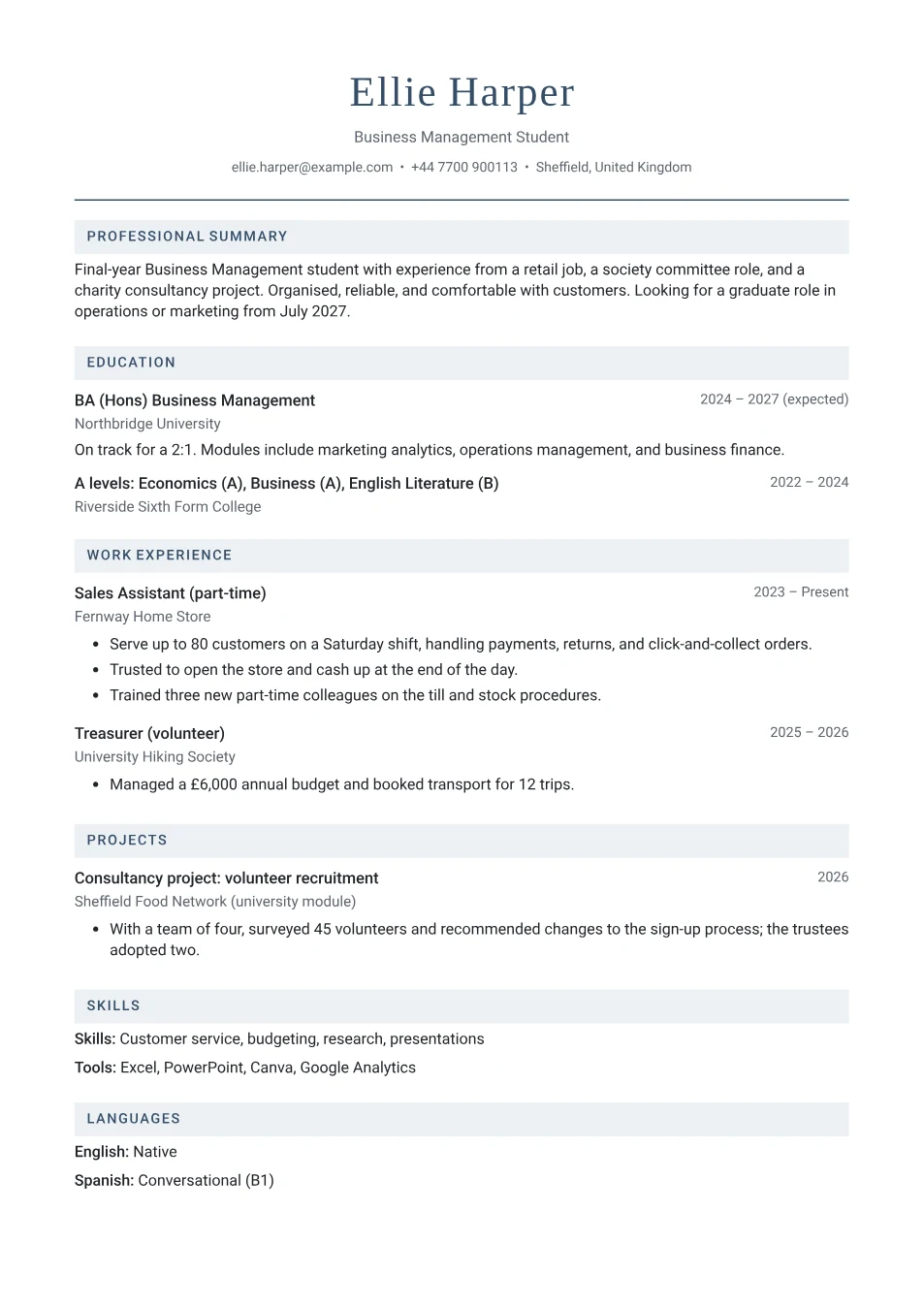
The short answer
Put the strongest relevant evidence first: usually education and projects for a new graduate, or a directly relevant placement when you have one. Select modules, explain your own project contribution, and keep completion status accurate. Use part-time work where it adds evidence rather than treating a different job title as irrelevant.
See the worked exampleWorked example: choose evidence for a reporting vacancy
Imagine a graduate has a dissertation involving survey data, a shop job, and a society role. The vacancy asks for accurate reporting and clear written explanations. The dissertation and the shop's record checks may be more useful than a full module list. Give them space in their actual settings.
This is a selection exercise, not permission to rewrite unrelated work as an analyst job. Keep the official job title, explain the relevant task, and use Education or Projects for academic analysis. The result should show the connection without blurring the origin of the experience.
| Evidence available | Useful detail to include | Detail to shorten |
|---|---|---|
| Survey dissertation | Cleaning responses and explaining sampling limits | A long list of every report chapter |
| Part-time shop work | Checking weekly stock records | Routine duties unrelated to the vacancy |
| Student society role | Preparing a short attendance report | The society's full history |
Choose the role before listing your modules
Read the vacancy and identify the work the graduate will be expected to do. Build your first draft around a small set of relevant requirements, not everything you studied. Keep a fuller record separately so tailoring one application does not mean losing useful details for another.
Write a short profile that names your field and a relevant example. Avoid broad promises about being a future leader when a concrete project would be clearer. The student summary guide offers structures you can adapt with graduate-level evidence.
Select academic details instead of reproducing a transcript
Include the qualification, institution, and completion date. State a final grade or classification only when it is confirmed and useful; clearly label a predicted result or unfinished course. Select relevant modules rather than turning the section into a transcript.
Harvard's resume template marks GPA, thesis, and relevant coursework as optional. Use that as a selection prompt: include an item when it helps explain your fit or the employer asks for it. A relevant dissertation can have its own Projects entry; there is no universal requirement to list every mark or module.
Explain what you did in a project
Describe the project setting, your contribution, the method or tools, and what you produced. Distinguish an individual dissertation from a group assignment. A completed report or tested prototype can be a clear result even when there was no commercial customer or financial outcome.
Use only figures you can support. Do not turn a classroom exercise into client work or imply that a university grade proves workplace performance. Read how to describe projects for a fuller method of choosing the details.
Keep useful evidence from part-time and volunteer roles
LSE highlights part-time work and extracurricular responsibilities as potentially useful graduate evidence. Select examples that explain your own contribution and how a skill transfers to the vacancy. Do not remove a role solely because its title differs from the graduate job, or give every past role the same amount of space.
Balance the space according to relevance. A directly related placement may deserve more detail than an older casual role, while an unrelated role can stay as a short entry. Keep dates consistent and state whether a placement was a short assignment rather than implying a longer period.
Sources: LSE Careers: CVs, profiles, and application structure
Review the whole application as a set
Check that skills named in the profile have evidence below, project links open, and qualification dates match the application form. Read the job's requested format and any supporting questions. A tailored CV does not replace required answers or a requested cover letter.
Use the student and graduate CV maker for the document and the cover letter maker if a letter is required. Save both the editable draft and the exact PDF you submit so interview preparation is based on the version the employer saw.
- Current contact details and working links.
- Accurate completion status and dates.
- Clear individual contribution to group work.
- Relevant skills supported by specific examples.
Check your graduate evidence
- The final or predicted qualification result is clearly labelled.
- Selected coursework relates to the advertised work.
- A group project distinguishes your contribution from the team's outcome.
- A placement is described with accurate dates and responsibility.
- Every portfolio link opens without an access request.
Frequently asked questions
Should education come before work on a graduate CV?
It often helps when your degree and projects are the strongest evidence. Put a directly relevant placement or substantial work first if that makes the fit clearer.
Do I need to list every university module?
No. Select relevant modules and give useful projects enough explanation. Keep the full academic record for applications that request it.
Sources and further reading
Sources checked on . Examples are fictional; practical suggestions are Folio's own application of the guidance.