Passionate about teaching gives a school little evidence of your classroom work. A short teacher CV profile can do more by naming your teaching context and one specific practice. Use it to introduce the application, then answer any requested supporting statement separately.
The short answer
Name your actual subject or age range, your accurate experience or training status, and one classroom practice relevant to the vacancy. Keep the profile short and evidence-based. A CV profile does not replace a school's criteria-based supporting statement or a teacher-training admissions statement.
See the worked exampleWorked example: replace enthusiasm with classroom evidence
Suppose a trainee wants to highlight adapting explanations. A useful profile can mention supervised lessons, the checks used to spot a misunderstanding, and how the next task changed. It should not imply independent responsibility for a whole year group's progress.
Choose a practice you can explain in more detail if asked. Keep the pupil group broad and avoid identifying an individual learner. If the vacancy is for a different phase or subject, change the focus using your actual experience rather than borrowing terminology from the sample.
Name your teaching context accurately
Identify the age range, subject, or setting you have actually taught. State a qualification or professional status only if you hold it, and use the terminology appropriate to the vacancy. Requirements vary by employer and location, so check the school's instructions rather than relying on a general CV example.
If you are still training, say so. A completed placement can provide valuable evidence without being described as several years of independent teaching. Keep full qualification names and dates in Education or Certifications rather than crowding the opening paragraph.
Choose a classroom contribution that matters to the role
The National Careers Service's primary teaching profile includes lesson planning, preparing materials, marking work, and discussing progress. Use the vacancy's actual age range and subject to choose your evidence; a primary role profile does not define every teaching job. Describe a practice you carried out and the responsibility you personally held.
Avoid unsupported claims about pupil results. If you mention an outcome, be clear about the group, period, and your contribution. Do not include identifiable pupil information or confidential classroom records to make an example more persuasive.
Sources: National Careers Service: Primary school teacher role
Use placement evidence for an early-career profile
An early-career profile can connect your subject knowledge to a specific placement responsibility. Mention the work you planned or supported and the part you completed under supervision. There is no need to imitate a senior teacher's leadership profile.
Keep descriptions consistent with your experience entries. If you supported a lesson rather than delivering the whole sequence independently, use that wording. Evidence of reflection, preparation, and collaboration can be useful without exaggerating the scale of responsibility.
Connect to the school without copying its wording
Select one relevant priority from the advert and explain how your practice connects to it. Avoid reproducing the school's values as a string of adjectives. A particular example of adapting a task or contributing to a department is easier to understand.
The summary builder can give you a first structure, but it uses predefined patterns and cannot evaluate classroom practice. Read its output carefully and remove any sentence that overstates your role, qualifications, or impact.
Answer a supporting statement separately when requested
Manchester's job-application guidance says to address a person specification and provide examples in a requested supporting statement; an uploaded CV is not a replacement. Use the short CV profile to orient the reader, then answer the school's criteria in the required form and length. Teacher-training admissions statements are another distinct application task.
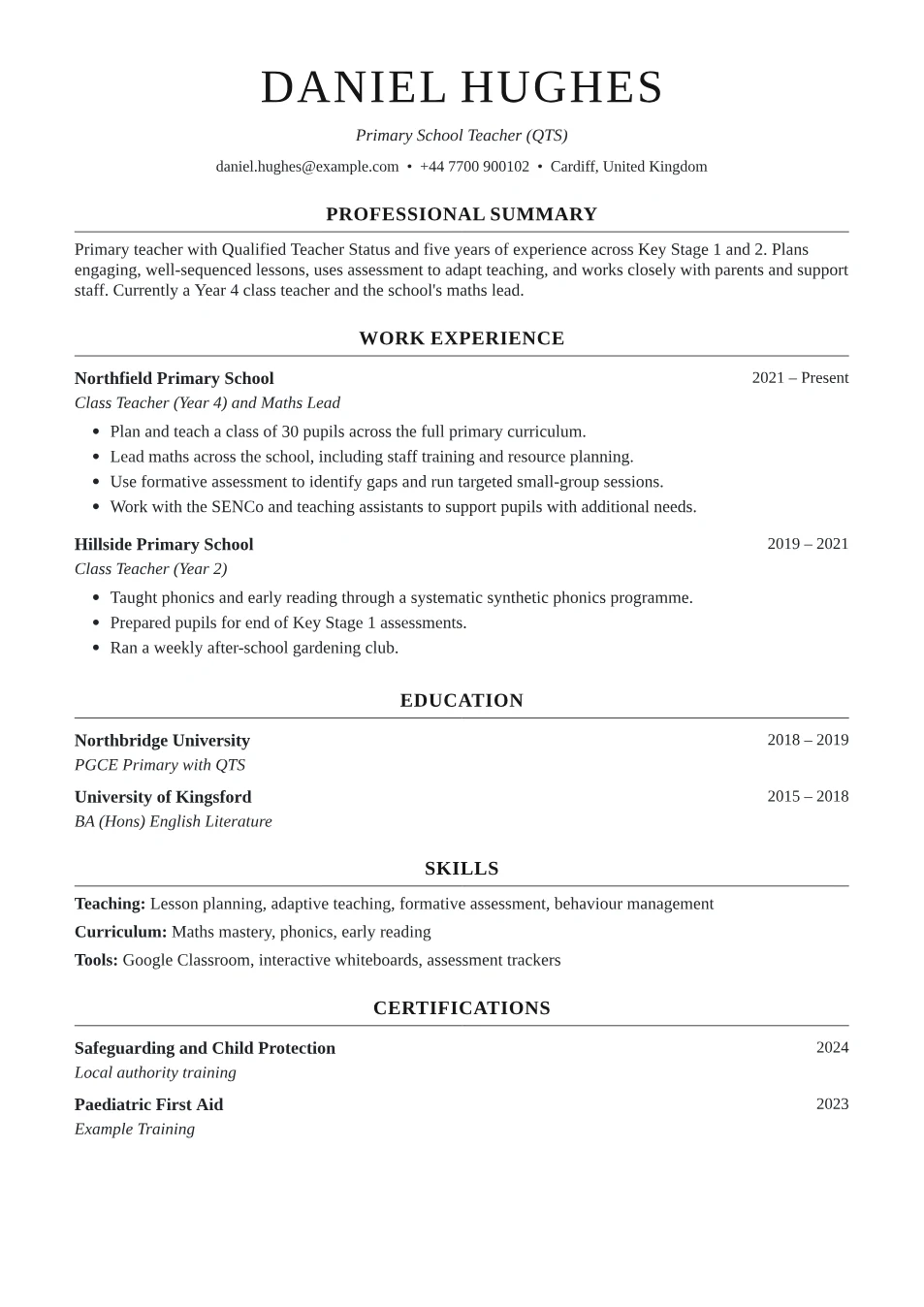
Start from the teacher CV example and review the employer's format instructions before exporting. If a separate letter is needed, use the cover letter guide to connect your evidence to the post without repeating every CV entry.
Sources: University of Manchester: Supporting statements for job applications
Review your teaching introduction
- Subject, age range, and qualification status are accurate.
- The named practice appears in an experience or placement entry.
- Supervised placement work is labelled clearly.
- No pupil can be identified from the example.
- Any requested supporting statement addresses the school's actual criteria.
Frequently asked questions
Is a CV personal statement the same as a school supporting statement?
No. The CV profile is a short introduction. A requested supporting statement may need a detailed response to the employer's criteria and word limit.
Can I include pupil progress figures?
Only use accurate, supportable figures that can be shared appropriately. Explain the context and your contribution without identifying pupils.
Sources and further reading
Sources checked on . Examples are fictional; practical suggestions are Folio's own application of the guidance.