An overseas employer or internal job title may be unfamiliar to a Canadian reader. Add enough context to explain your work while preserving the original facts. The examples below show how to clarify a title, describe an employer, and separate experience from credential recognition.
The short answer
Keep relevant overseas experience and explain unfamiliar employers, titles, and terminology. Describe your own contribution using the vacancy's language where it accurately fits. State credential assessments or professional registration only as documented, and follow the particular employer's format instructions.
See the worked exampleWorked example: explain a title without upgrading it
Imagine a candidate whose official title was Operations Executive at a regional distributor. The word executive may mean different things to different readers. Keep the title and explain the actual duties rather than replacing it with Operations Director. The description should establish the level of responsibility.
Use a short employer description when the organisation is unlikely to be known. Explain what an internal report contained instead of assuming its acronym is meaningful elsewhere. This makes the experience easier to assess while preserving facts that can be checked in an interview or reference.
Give unfamiliar employers a short description
Keep the organisation's real name, then add a brief description if it helps the reader understand the setting. Regional distributor, university laboratory, and customer support centre each provide context without needing a long company history. Keep confidential commercial information out of the explanation.
Use an accurate job title and explain the work in the description. If a literal title would be unfamiliar, add a plain-language clarification rather than replacing it with a more senior Canadian title. The aim is understanding, not upgrading the role.
Choose evidence that connects to the Canadian vacancy
Job Bank's guidance for employers encourages recognising international experience and asking for concrete examples of relevant skills. For your resume, our practical application is to make that evidence easy to interpret: explain the setting, your contribution, and any unfamiliar terminology without changing the facts or implying that overseas work is less valuable.
The resume keyword checker can show differences in wording, but it does not assess whether two roles or qualifications are equivalent. Keep the details truthful and describe the actual tasks. A relevant overseas example remains relevant without a Canadian employer name attached to it.
Sources: Government of Canada Job Bank: Recruiting newcomers
Check recognition before describing local equivalence
Job Bank's newcomer guidance recommends checking whether the occupation is regulated and whether credentials are recognised. Its recognition tool points to the relevant authority. Use the actual outcome of any assessment or registration in your resume; a translation of a qualification name does not establish a Canadian equivalence or permission to practise.
Describe language skills in terms you can support, such as the kinds of conversations or documents you can handle. Keep course attendance, test results, and workplace use distinct. Use the Languages section to make this information easy to find without repeating it throughout the CV.
Sources: Government of Canada Job Bank: Job search and credential recognition for newcomers
Treat general format advice and employer instructions separately
Canada's Job Bank advises a concise, tailored resume and generally limits it to two pages. Its guidance also says photos and a Social Insurance Number do not belong on a resume, and that references should be provided separately when requested. Follow any specific application instructions alongside that general advice.
Length advice can differ: the City of Toronto's own hiring guidance asks for two to three pages, while Job Bank's general guide says two. Follow the particular employer's instructions. Read the Canadian format guide for context, and keep sensitive identity or qualification documents out of a widely shared resume.
Sources: Government of Canada Job Bank: How to write a good resume; City of Toronto: Job application tips for its hiring process
Build a readable document and check its limits
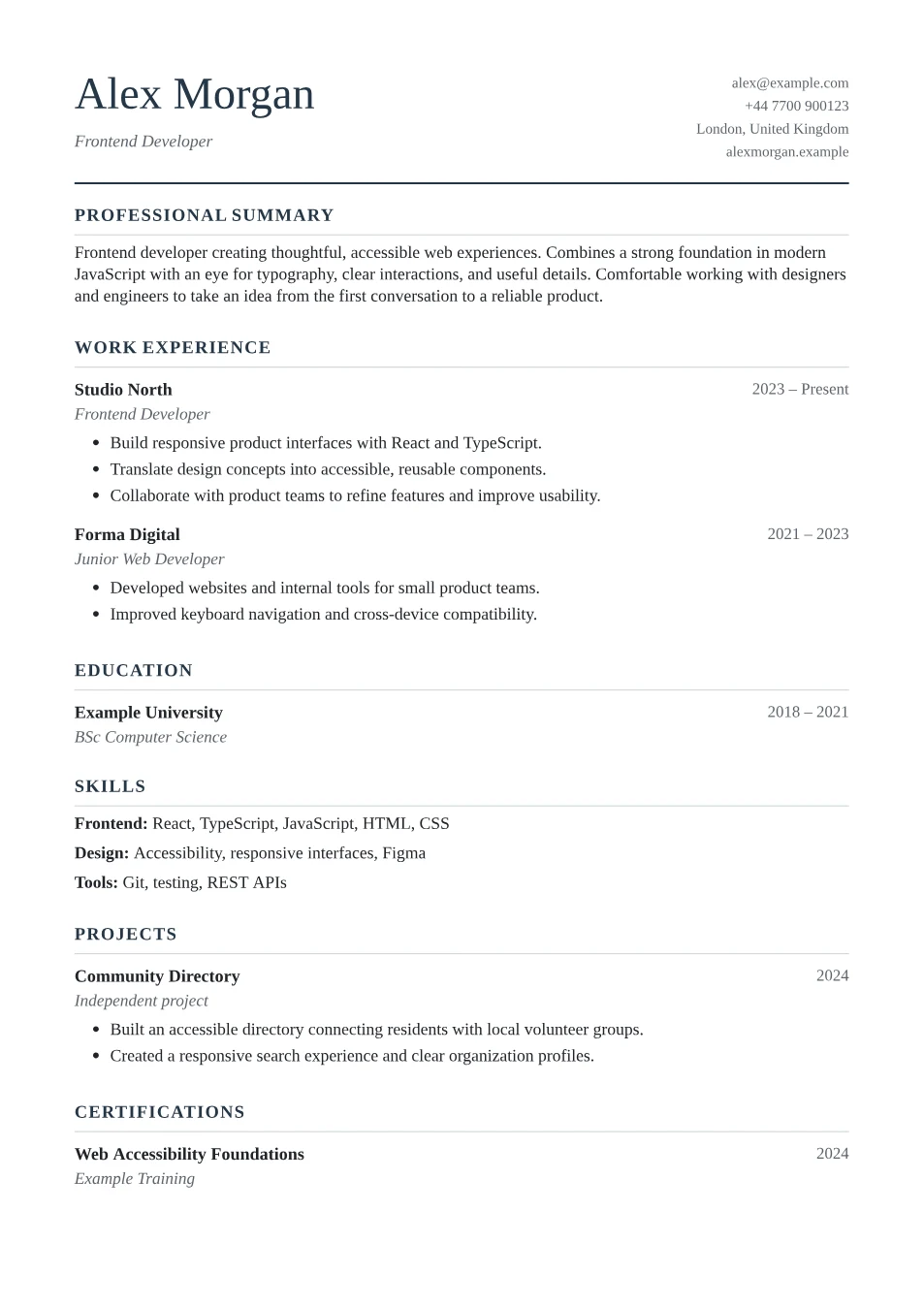
Choose a plain layout such as Professional or Clarity, put the most relevant evidence first, and keep dates consistent. Add local volunteering, courses, or projects if you have them and they help the application; do not invent activities to make the resume look local.
Folio's free editor creates A4 PDF CVs. If an employer requests Letter size, Word, or a particular form, follow that requirement. Save an editable draft, check the downloaded file, and keep the version submitted with the vacancy so you can refer to it at interview.
Check the context around overseas experience
- Employer names and official job titles remain accurate.
- An unfamiliar organisation has a short, useful description.
- Acronyms and internal system names are explained where needed.
- Credential assessment or registration status matches your documents.
- Your format follows this employer's instructions, not a universal length rule.
Frequently asked questions
Should I remove all overseas work from a Canadian resume?
No. Explain relevant experience with clear employer context, accurate titles, and specific contributions. Overseas work can still show the skills requested in the vacancy.
Can the keyword checker confirm a qualification's equivalence?
No. It compares text. Describe any qualification assessment or registration using the actual status provided by the relevant organisation.
Should I replace an unfamiliar job title with a Canadian one?
Keep the accurate title and add a plain-language clarification if needed. Do not choose a more senior title or imply a different level of responsibility.
Sources and further reading
Sources checked on . Examples are fictional; practical suggestions are Folio's own application of the guidance.