Accountant CV profile examples
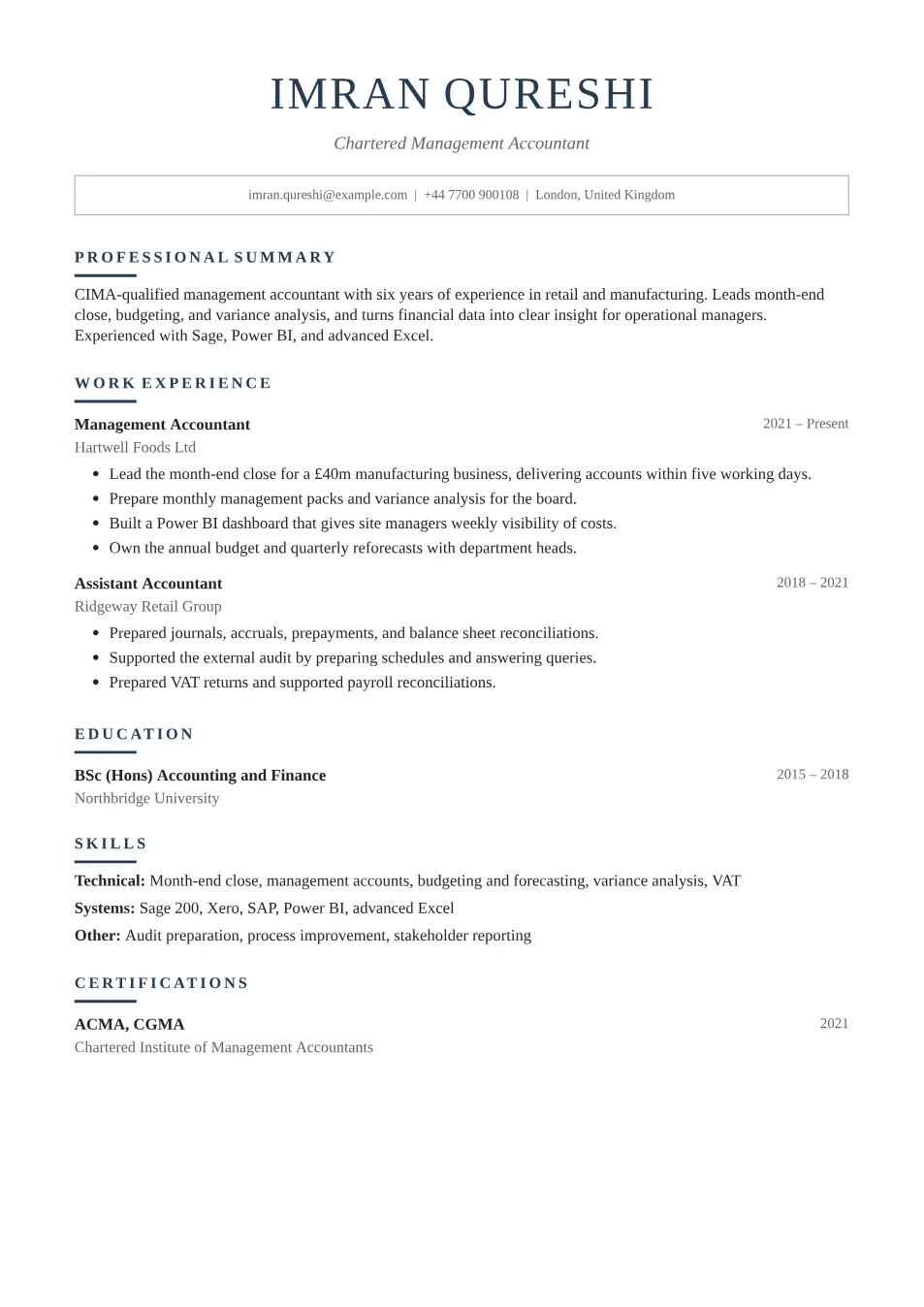
The profile at the top of a accountant CV should tell the reader who you are, what you do well, and what you are looking for, in two to four sentences. The example CV uses the first version below; these alternatives show how the same role reads at different stages.
Accountant CV bullet points
Start each point with an action and finish with a result or useful detail. Use these as a model rather than copying them: swap in your own numbers, settings, and tools so every line is true for you.
- Reduced the month-end close from eight to five working days by automating reconciliations.
- Prepared monthly management accounts and board packs for a £40m business.
- Identified £250k of annual savings through supplier cost analysis with the procurement team.
- Led the annual budget process with ten department heads and prepared quarterly reforecasts.
- Built a Power BI dashboard that gave site managers weekly visibility of costs.
- Completed balance sheet reconciliations with no material adjustments raised at audit.
- Prepared and submitted quarterly VAT returns under Making Tax Digital.
- Trained two assistant accountants in journals, reconciliations, and Excel modelling.
Skills for a accountant CV
Choose the skills that match the job advert and that you can back up with an example from your experience.
Technical skills
- Management and financial reporting
- Budgeting and forecasting
- Variance analysis
- Reconciliations and journals
- VAT and compliance
- Advanced Excel and Power BI
Professional strengths
- Commercial awareness
- Explaining numbers to non-finance colleagues
- Accuracy under deadlines
- Process improvement
- Integrity and discretion
Tips for writing a accountant CV
Make your qualification status unmistakable
State whether you are qualified, part-qualified, or studying, and with which body, such as ACCA, CIMA, or ICAEW. If you are part-qualified, say how many exams you have passed.
Give context about the business
Turnover, number of entities, sector, and team size help a reader understand how complex your role was. A short line of context for each job is enough.
Show improvement, not just routine
Every accountant does month-end. Stand out by describing what you improved: a faster close, clearer reports, cost savings, or a smoother audit.
The template in this example
This example uses the Regent template (serif nameplate, framed contact line). Its traditional styling suits conservative fields such as law, finance, the public sector, and academia, where a familiar format is often expected. You can switch to any of the 40 templates in the editor without retyping, and change the colour, font, and spacing.